Working towards the upcoming concours for my 1963 E-Type FHC at Little Switzerland, NC, I have been thinking about things that could go wrong. Previous concours disasters have included the car not wanting to start and the brake lights not functioning. Having just come back from an extended trip to Europe, I realized that the car had not been started in a while. Simple enough. Get the battery fully charged, turn the key, and see what happened. Now realize that this car is a trailer queen. The odometer currently reads 41 miles. Yes, you read that right. 41 miles since I initially drove the car out of my driveway in January of 2025. And most of those miles were put on during “shakedown” in the spring of 2025. So there is an excellent chance that a large portion of the gasoline in this car’s tank is over a year old. I am not here to defend the concept of not driving one’s E-Type. I have covered that ground in previous articles in this series. But I am a little worried about year old gas.
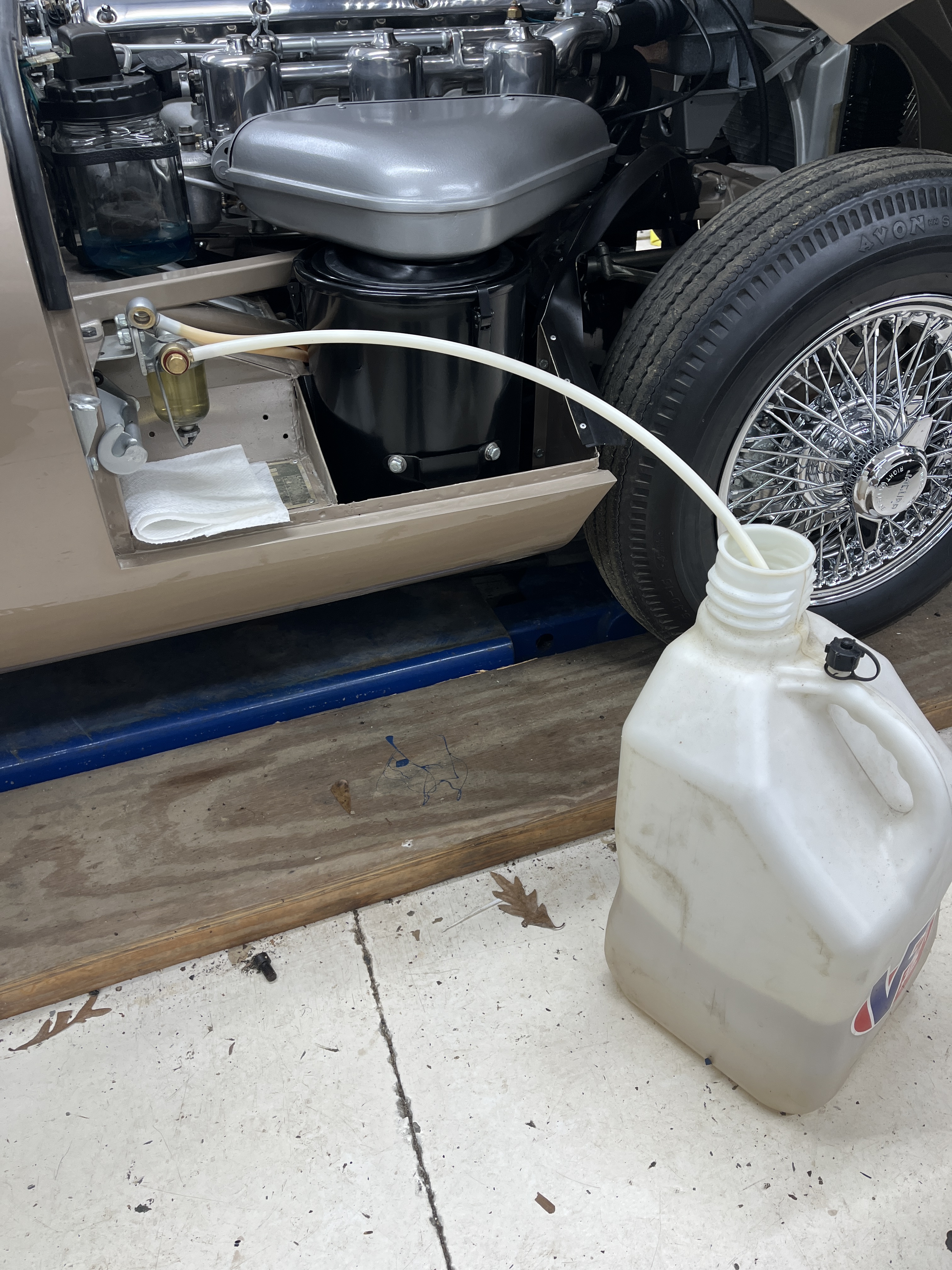
I did a little reading on the internet, where all technical subjects seem to be covered, sometimes even by people that know what they are talking about. There seems to be a wide range of opinions, with some folks claiming that gas in the tank can “go bad” in a few weeks, whereas others say it is good for several months. The storage conditions of the gas and the possible additive package seem to make a big difference. Maybe “high test” from a brand name service station does better then some but, as usual, real world data seems to be all over the place. But no one was saying that year old gas in the tank was nothing to worry about. So, just to be safe, I rigged up a simple connection at my fuel filter and used the electric fuel pump to pump the tank dry. About 3 gallons came out. I purchased some fresh 93 octane at the local BP station and filled my tank until the low fuel light went out, also about 3 gallons. I feel better now. And the car started right up!
This led me to think about what exactly bad gas is. I think it can be broken down into two broad categories. If stop at a service station, get a fill up, and your car immediately is running poorly or not at all, you may have pumped bad gas from the station’s underground tanks into your car. This happened to me once with my Porsche 944. Drove in. Car running fine. Drove away. It would hardly run. I pulled over and after some thought, decided to call for a tow home. I drained my tank and added new gasoline (from a different station). The car started right up. Bad gas! It seems that a common scenario is that the gas in the underground tank was contaminated with water. Cars do not like to run on water! A less likely scenario is that the gasoline in the tank was somehow contaminated with whatever, to the point that the gasoline would not support combustion. A really ugly option is that you managed to pump diesel fuel into your car! Generally, the filler spout for diesel is a larger diameter than the opening in the car’s fuel port but still, it does happen.
A corollary to this is where water had gotten into the fuel tank on your car. Again, looking at the internet, I see a couple of suggestions that make sense, if you are planning on not starting or running your car very much. Most seem to center around the fact that the fuel tanks, especially on older cars, are “vented”, i.e. as the fuel draws down in volume, outside air is pulled into the tank. Here in North Carolina, that air can be quite humid, which means it contains some water vapor. The thinking goes that the humid air is drawn into the tank, where under some conditions, the water vapor will condense. Since gasoline and water don’t mix, and even worse water is heavier than gasoline and will settle to the bottom of the tank, then you may get a situation where you try and start your car and suck water into the fuel system. Not normally a good thing! Off course, newer cars have a system that sends vapors from the fuel tank through a system that introduces them to the intake manifold, where they are burned off. These systems are more air tight than the one on my E-Type, which has a small vent hole in the gas cap. But even these systems have check valves that will allow outside air to be drawn in, in order to keep your fuel tank from collapsing. I am actually surprised to read that fuel vapor recovery systems began to be required by the EPA as far back as 1971. One suggestion is to fill you fuel tank very full right before you store you car, to minimize the air space that can contain water vapor.
Gasoline with ethanol, typically 10%, was also introduced in the 70’s. This seems to be more of an effort to reduce the dependency of the US on foreign oil, and to also give a boost to corn farmers. Well, my goodness, I hear car guys talk about ethanol based fuel like it is evil incarnate. I’m not going to tackle that subject except to point out that the ethanol in gasoline does readily combine with water (think vodka tonic) and this mix will pass through the engine as long as the mix doesn’t get too strong. There is an argument that ethanol based fuels are helpful, from that standpoint. I think 98% of us don’t think twice about ethanol fuel, because it has been around for decades now.
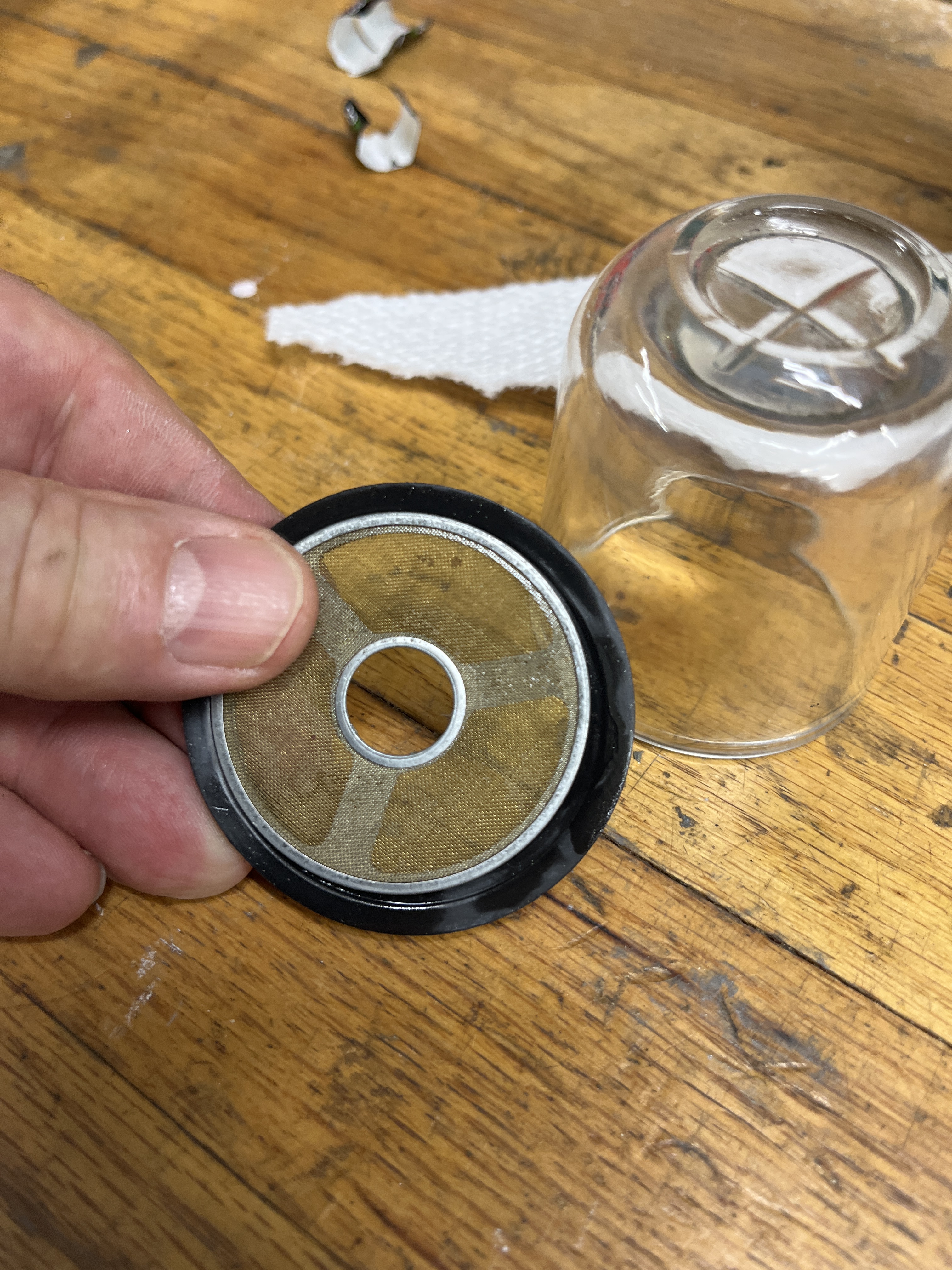
The internet also discusses the fact that gasoline, allowed to age, even in a closed container (no access to water vapor), may turn dark brown and smell bad. It is breaking down chemically to a point where it does not support combustion. Fortunately, the gas I pumped out of my E-Type was not dark in color and did not smell bad. But if you find you have doubts, maybe remove your gas cap and give it a sniff test. A related issue is particle contamination that clogs your fuel filter, fuel injectors, etc. This apparently can happen with old gas and maybe more rapidly if the gas being pumped from the service station has particle contamination. Apparently gasoline will turn to a jelly if left around long enough! BTW one quirk of my E-Type is that the fuel filter is a mesh screen that sits above a clear glass bowl of fuel. The correct connection to this filter element sends the incoming fuel to the top of the mesh screen. So in effect you can’t see if particles have collected. But I do know that if the screen gets badly blocked, the glass bowl will show with an air space. If you see an air space, disassemble the glass bowl and check/clean the mesh screen. A picture of the mesh screen is shown below.
You may ask about fuel stabilizers. I find mixed reviews of these products, of which there are many to choose from. I guess you can say they don’t hurt but I even found a Hagerty article where they found cases on the stabilizers having chemical compounds that attacked materials in the fuel system. This seemed to apply to older cars from before the 70’s, before manufacturers had to upgrade the materials in the fuel system due to the introduction of ethanol laced fuels.
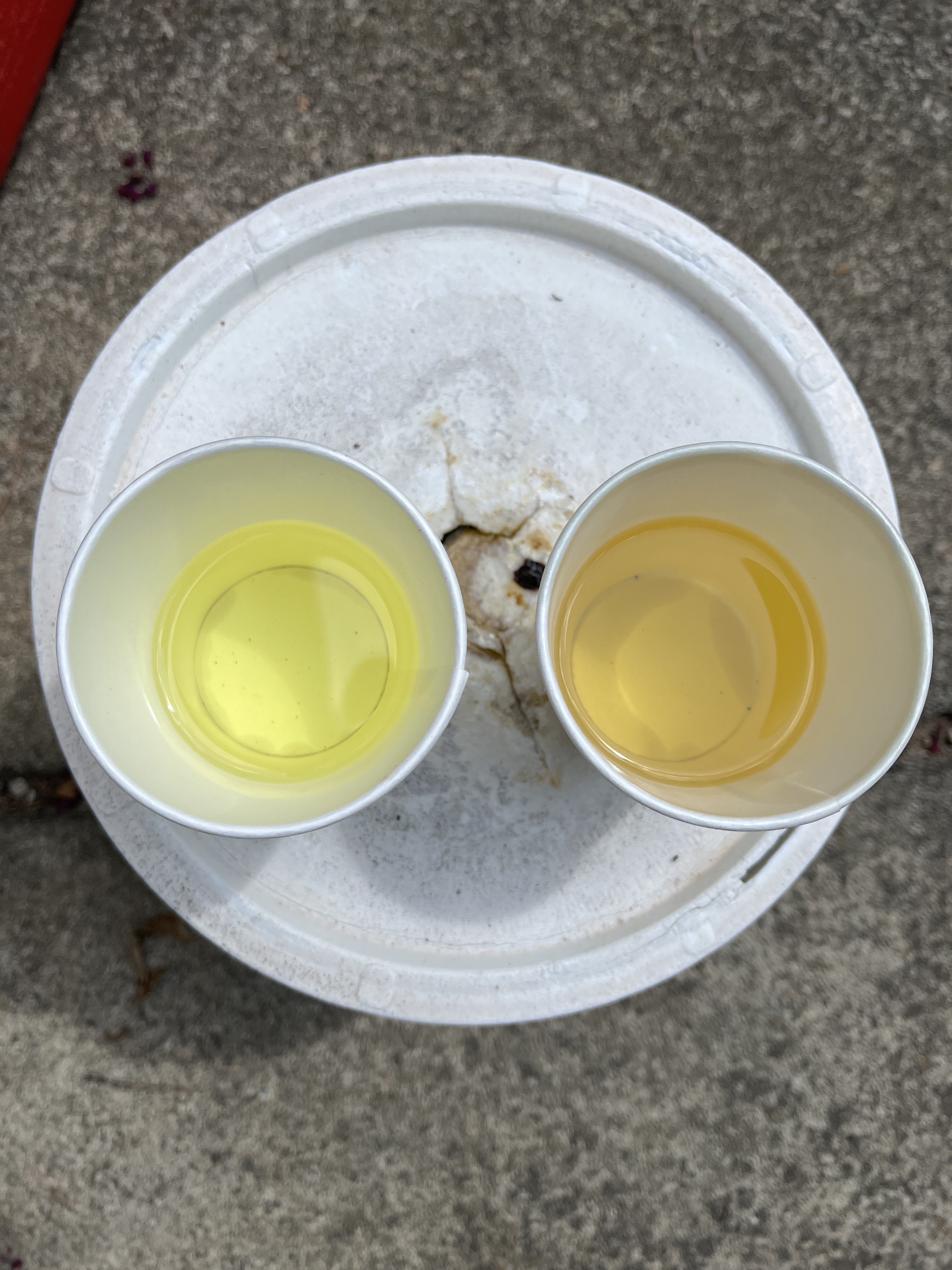
And finally, you may ask about the gas that I drained from my tank. I poured my old gas and my new gas into separate cups. As you can see in the photo, the old gas was darker than the new gas. But they both smelled the same. I threw caution to the winds and added a gallon or so to the 3/4 full tank of my F150 i.e. it was heavily diluted. After driving around in my truck, I found no adverse effects. So whether I had “bad gas” is inconclusive.
The best policy is to drive your car. Kind of like exercise for us humans, cars do better when exercised on a regular basis. Seals don’t get dried out. Moving parts get fresh lubricants applied to them. And you get to enjoy your car. And, unlike me, you won’t have to worry about bad gas.


Discussion
Comments are closed.