Several of my friends who are restoring Etypes talk about the “rabbit holes” that we go down. This is basically shorthand for when we get really involved in exploring a detail of Etype construction that we may be trying to understand and potentially replicate. One such area for me is the classic “Knock-offs” used to retain the wire wheels on the car.
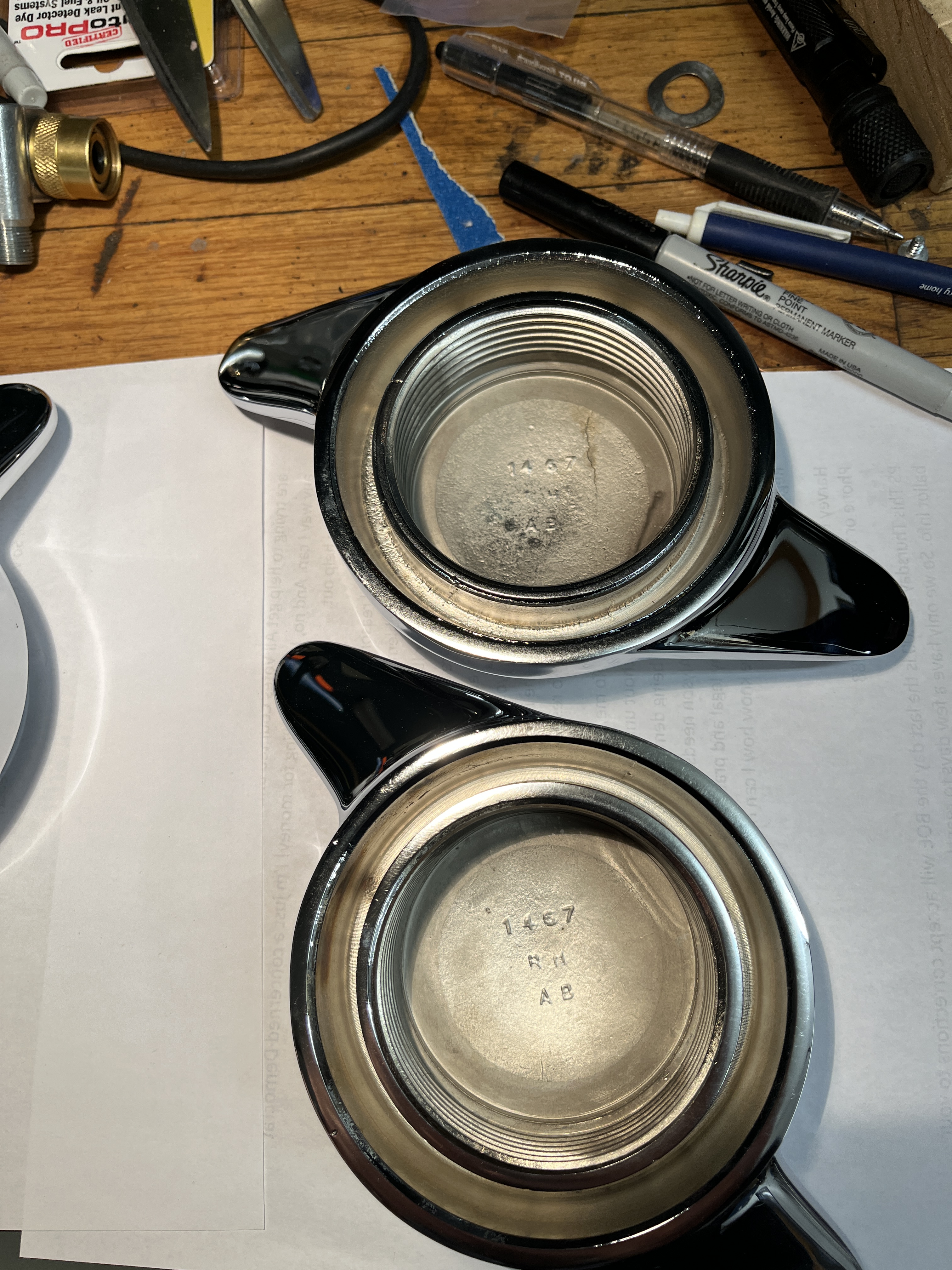
One of my first surprises was to find that when you looking for these devices in the Jaguar Spare Parts Catalog (SPC) they are called “hub caps”. Of course, this made no sense to me, being raised around American cars where a hub cap was metal disk that went over the center part of the road wheel and hid the lug nuts. But for me, I think of them as knock-offs because you have to remove them by knocking them off using a hammer. And of course, some folks call them Spinners. Maybe in homage to the chariot race in the movie Ben Hur! For my “car in a box”, I found 4 knock-offs that I determined to “probably” be original to the car, based on markings on the back side of each one. More on that below. In my case, I decided to restore the ones I had, for the sake of authenticity and soundness of wheel attachment. BTW I was somewhat shocked to find that you can currently buy reproductions from SNG for about $130 each. I have no idea how they make them for that cost. But as I read resources like the EtypeUK 3.8 Factory Fit forum, I found that the astute observer can spot flaws on the repos. More on that below. So I embarked on getting mine restored.
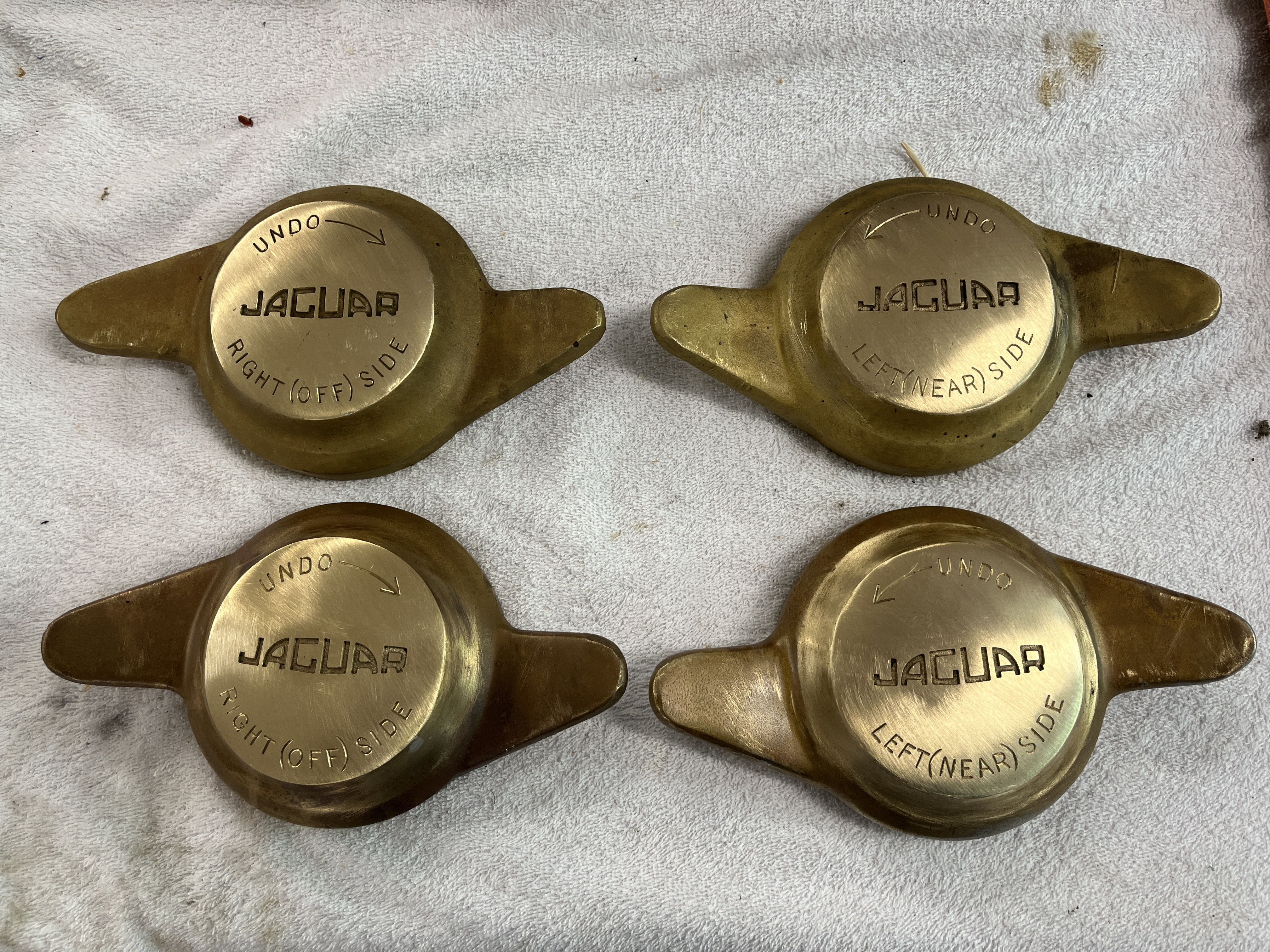
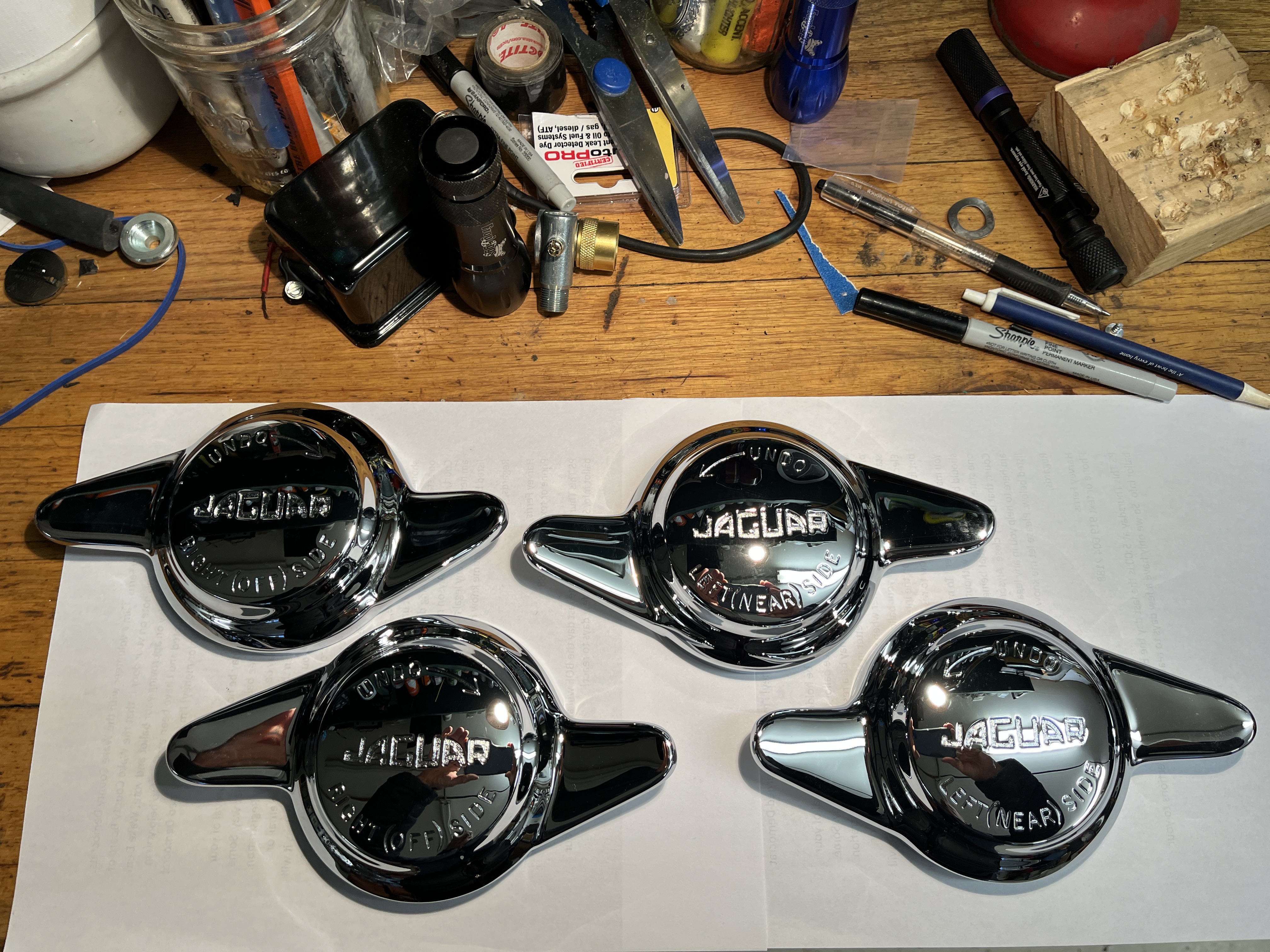
Restoration obviously involves getting the chrome plating redone. I was advised that for the best job, I should have the lettering on the knock-offs “enlarged” so that when they were chrome plated, the lettering would retain a crisp appearance. My knock-offs were sent to an older gentleman in PA, Joe Kostelnik, that did custom engraving in preparation for chrome plating. BTW, the chrome platers removed all the old plating, such that they were back to their original brass. This is how I sent them to the engraver. This plating removal is done as the first step for all show chrome plating jobs but normally we never get to see them in that state. Anyway, there is a picture below of the bare items as I received them from the engraver. Next they went to the chrome plater, S&H in Nashville. I discussed the job with the shop foreman and he agreed to “mask” the internal threads so they wouldn’t become a fitment problem due to chrome buildup. They also have to solder a ground wire somewhere that will be out of sight. I asked them to be sure and not impact the raised lettering on the back side. They repaired some damage on the ears using their standard filler materials of copper and solder. As you can see in the photos, the final product looks fantastic. BTW, because this is a concours show car. I plan to transport the car with the reproduction knock-offs and just use my newly restored ones for shows.

I mentioned the UKEtype Factory Fit forum. Below, with their permission, I have cut and pasted the extensive background information posted by prolific historian David Jones. It’s a good read. The link is here. The article is half way down the page.
The ‘Hub Caps’ #C1102 and #C1103 also known as ‘eared knock-offs’ or ‘spinners’ were chrome plated manganese bronze drop forgings based on the Rudge Whitworth pattern with 52mm hub and 8tpi thread. They were made by Albion Drop Forgings Co a subsidiary of J Brockhouse & Co and are stamped ‘AB’ for Albion Brockhouse. Drop forging is a forging process where a hammer is raised and then “dropped” onto the workpiece to deform it according to the shape of the die. The threads and faces were then machined into the workpiece. The ‘Jaguar’ logo was not inked in (painted) on the S1 cars. Interestingly after Rudge-Whitworth went into liquidation in 1936 Jaguar acquired the rights to Rudge’s wheel business and together with Dunlop continued to exploit the design.
Height – 38mm (1.5″)
Diameter – 101.6mm (4″)
Outer wall thickness – 6.5mm (1/4″)
Inner wall thickness – 5.4mm (7/32″)
Depth from top of wall to bottom of casting – 31.6mm (1 1/4″)
Weight – 885gms (31oz)
The reproduction hub caps are a different size, shape and weight:
Height – 35mm (1 3/8″)
Diameter – 106.3mm (4 3/16″)
Outer wall thickness – 8.6mm (11/32″)
Inner wall thickness – 5.1mm (13/64″)
Depth from top of wall to bottom of casting – 27.45mm (1 5/64″)
Weight – 1107gms (39oz)
There are many other differences:
1. The originals have 1467 RH AB or 1466 LH AB cast into the base whilst the reproductions have ‘Made in England’ and, on one set, the number ‘8059’. AB stands for Albion Brockhouse.
2. Originals have grooved inner faces, the repro’s are smooth
3. The channel between the inner and outer walls is U shaped on the originals, square shape on the repro’s (could be the reason the latter can be problematic to remove)
4. The Jaguar logo on the repro’s is smaller, a different shape and has enlarged ‘A’ and smaller ‘G’ and ‘U’
5. The shoulder between the front face and ear section is much deeper and better defined on the originals giving a more svelte and lighter look
6. The length of the ‘Undo’ arrow is longer on the original
7. The position of the word ‘Undo’ is different on the original
8. The lettering for Left/Right side is in a different position on the original
9. The ears are fatter in section on the repro
10. The repro’s are half a pound heavier per wheel which does nothing to help un-sprung weight
11. Repro’s have the ‘Jaguar’ logo inked in with black paint, original’s on the S1 did not.
12. Inked Jaguar logo spinners appeared with the S2 cars (1968) and all service replacements after that date would have been inked
13. In 1967 Albion Drop Forging Co stopped forging and the work was moved to J. Brockhouse & Co at West Bromwich. This coincides with the fitting of inked Jaguar logo hub caps from 1968 onwards
An original set is far preferable to the likenesses, I hesitate to call them reproductions, currently available. Originals can be de-chromed, dressed, re-engraved and re-plated; it should be relatively easy to replace any that are too far gone as they appear on eBay quite often. They also fit a lot better on the hub threads.
Easiest way to spot an original is to compare the logo with the one on your oil filler cap – they should be identical.
Hub Caps and Oil Filler Lettering
The hub caps used on the E-Type were chrome plated with no additional detailing i.e. inking in of the Jaguar logo. In the case of the hubs after being drop forged and machined they were highly polished before being plated with copper, nickel and chrome. The polishing wheel could not reach into the Jaguar logo indent so it remained rough and this was reflected in the plating. The effect was a polished surface with a marbled chrome in the lettering indent which produced a contrast and highlighted the Jaguar name. No paint was applied as it would have been pointless and added to the cost, something Mr Arthur Whittaker (Jaguar’s chief buyer and cost cutter) would not have allowed. Similarly the oil filler cap was polished leaving the Jaguar lettering unpolished, in contrast. I have looked at over 100 Jaguar official photos and there is not one that shows inked in Hub Caps or oil filler. Over time the indented lettering can become polluted with road grime and oil giving the appearance of black paint but a quick clean will reveal there is none. Of course many owners detail their cars and the inked in logo is an easy enhancement. As far as I can tell the first appearance of the inked in eared hub caps was with the release of the 1968 S2 and first reproductions by Orson Engineering; this gave way to the view they were all painted. The S2 ‘Federal’ earless hub caps did have the Jaguar logo inked in.
 New Hill Garage
Discussion
Comments are closed.