A phrase you will hear bandied about at classic car auctions and web sites is “matching numbers”. In it’s simplest terms, this means that the identification numbers of the car’s key components match the ones it was “born” with. Collectors of “original” or “unrestored” cars place a lot of stock in Matching Numbers to help them know that the components of the car are indeed original. Of course, cars can be extensively restored and still have Matching Numbers. On the more nefarious side of things, copies or clones of significant cars can be generated. Going through the exercise to determine if a car has Matching Numbers can help identify these situations, although if the bad guys are good, they will fake the Matching Numbers part of things too. That said, all cars have a VIN (vehicle identification number) although they may go by different terms based on country of origin and when the car was built. On an Etype, and really all old Jaguars, the equivalent term is the Car Number, at least that is the term used on the Data Plate for my 1963 and 1967 Etypes. In some states, such as California, the VIN number had to be a certain minimum number of characters and the Car Number was appended with additional characters to make it agree. Here in North Carolina, my title for the 63 FHC lists the VIN number as J63888055, which is basically a J for Jaguar, 63 for the title year, and the remaining characters are the 6 digit Car Number. But all of that is about the identifying number for the car as used on the Title. It had better match or you’ve got legal problems to deal with. What is of interest to collectors and enthusiats are the other numbers associated with the car. The Data Plate on my 63 FHC lists a Car Number, Engine Number, Body Number, and Gearbox Number. So if every number for those items matches what is actually in the car, you have a “Matching Numbers” car. My car is a partially Matching Numbers car but we will get to that in a minute.
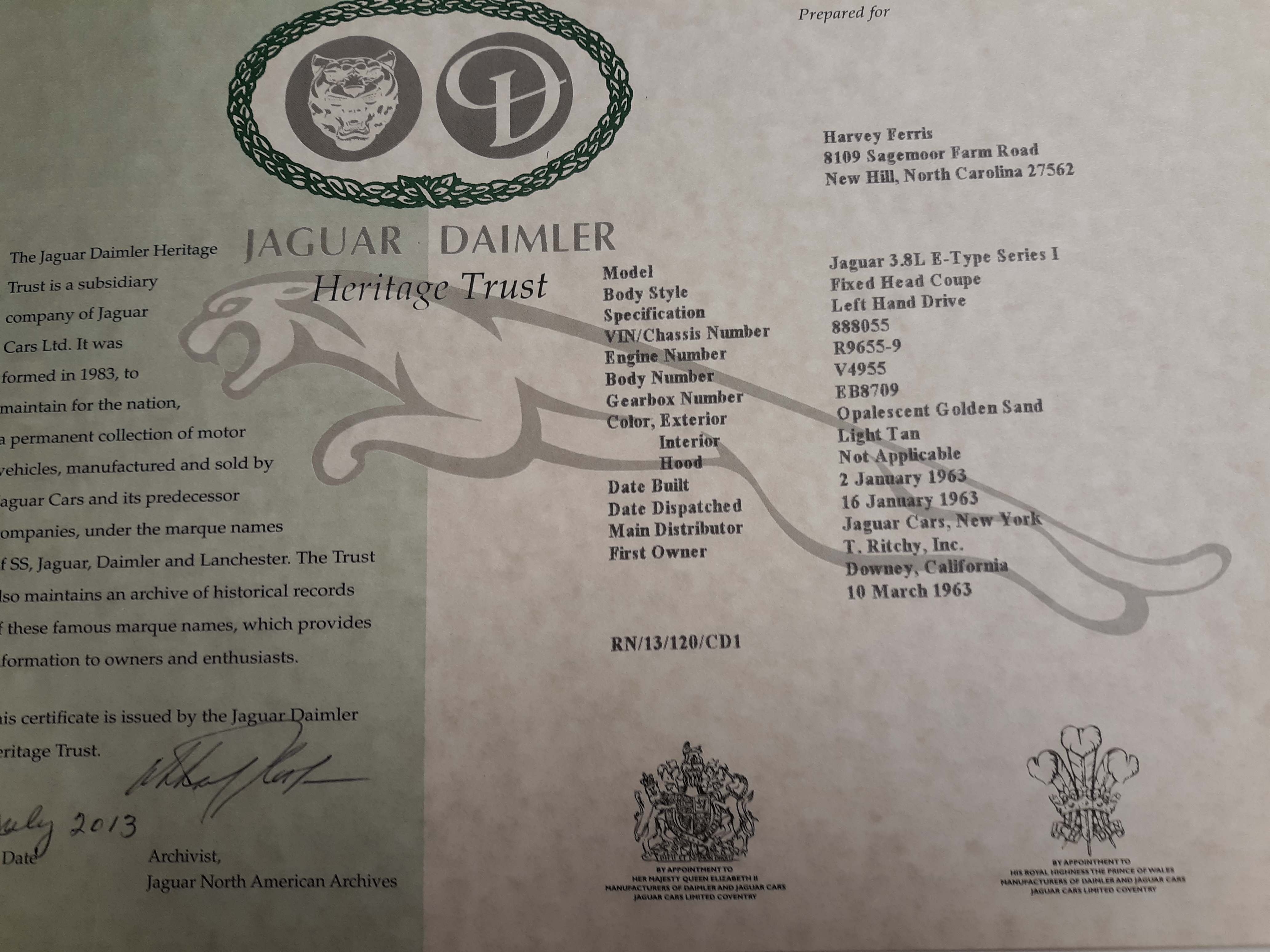
The Data Plate on an Etype is mounted on the passenger side of the engine compartment and, as noted above, it stamped with the Jaguar numbers for the Car, Engine, Body, and Gearbox. This would seem pretty solid but Data Plates can be forged. If you want a fairly ironclad confirmation, you can apply for a Heritage Certificate from the Jaguar Daimler Heritage Trust. They maintain the original records for the cars Jaguar built. For a fee, they will research their records and confirm the information on your Data Plate. The Heritage Certificate also lists the original exterior and interior colors, the build date, and if available, the name of the first owner. Other marques have similar but different variations on this theme.

Data Plate
The book I have mentioned previously, Jaguar E-Type Six Cylinder Originality Guide, does a good job of explaining where the various numbers can be found on your car. It is rather complicated so I won’t go into that here. But here is what I found for the 63 FHC. My Car Number is 888055. It is listed on the Data Plate and is stamped on the top of the “picture frame”, a part of the engine and suspension support structure.

Car Number Stamped on Top of Picture Frame
The Engine Number, R9655-9, can be found in two places. It is stamped on the cylinder head and on the block, right above the oil filter.
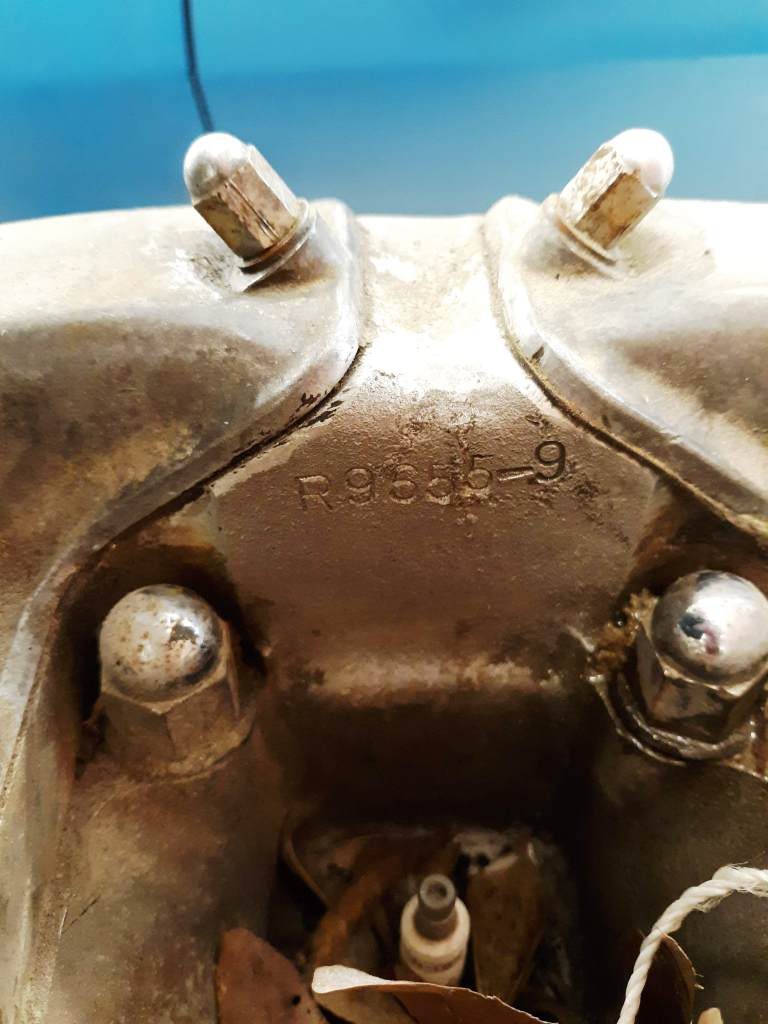

Engine Number Stamped on Block
Of secondary interest is the Engine Block Number. This is a more generic number for the series of block casting used.
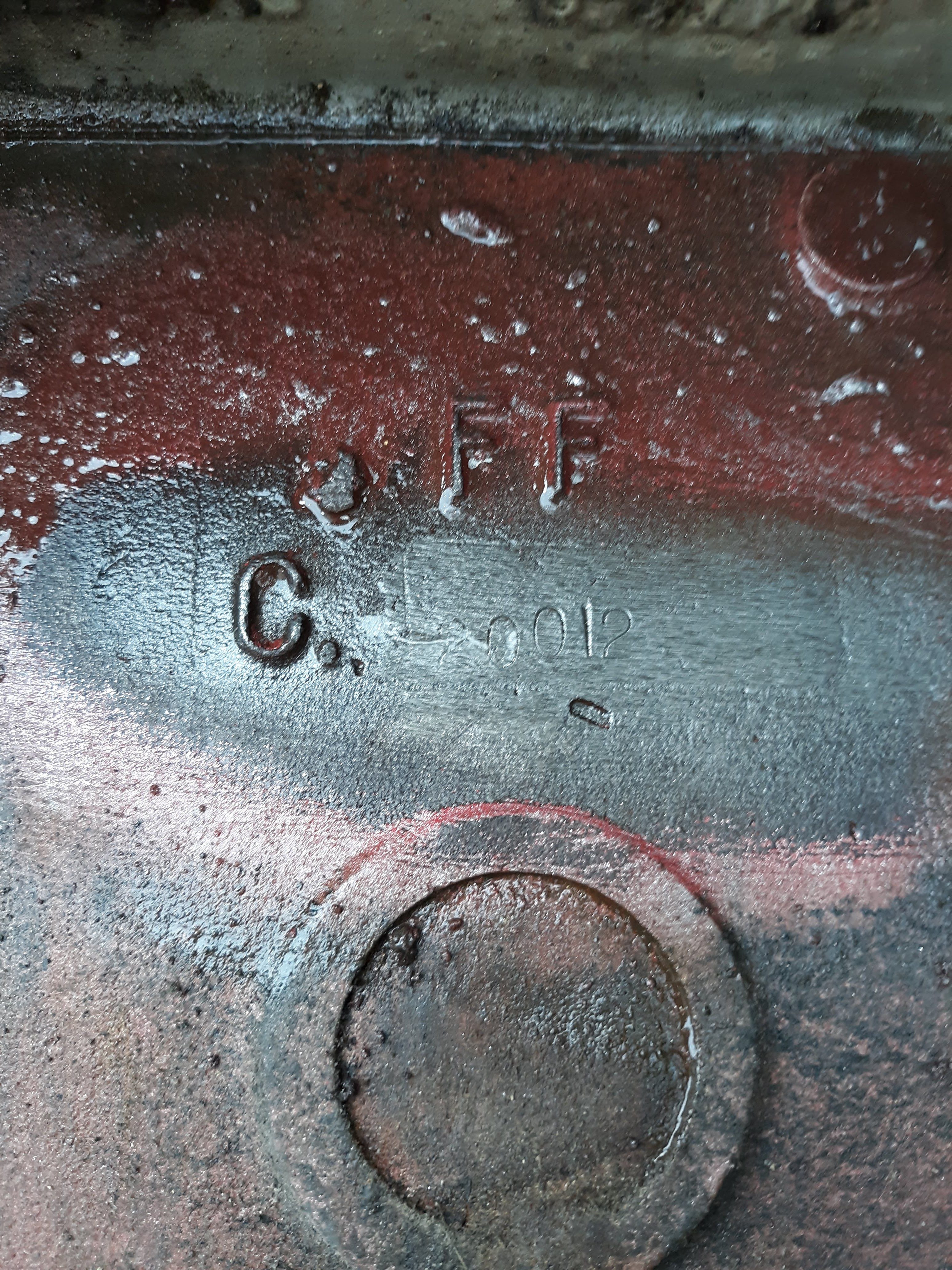
Engine Block Number
The next thing I looked at was the Body Number. On this car, it is a small plate riveted to the inside surface of the driver’s side rear fender well. On a finished car, it is covered up by glued on upholstery but in my case, it was there to see, albeit faded. It’s hard to read but I’ll help you out. It says V5139. Not the number on my Data Plate. I contacted Jaguar Heritage Trust about this issue. They stood behind the number on my build record, V4955.

Body Tag
One of my followers, Tony, sent me an email. He pointed out that if you look closely in the above photo, above the metal body tag, you can see faintly in blue the numbers 4955. I went out to look at the car again and I can make it out, very faintly.
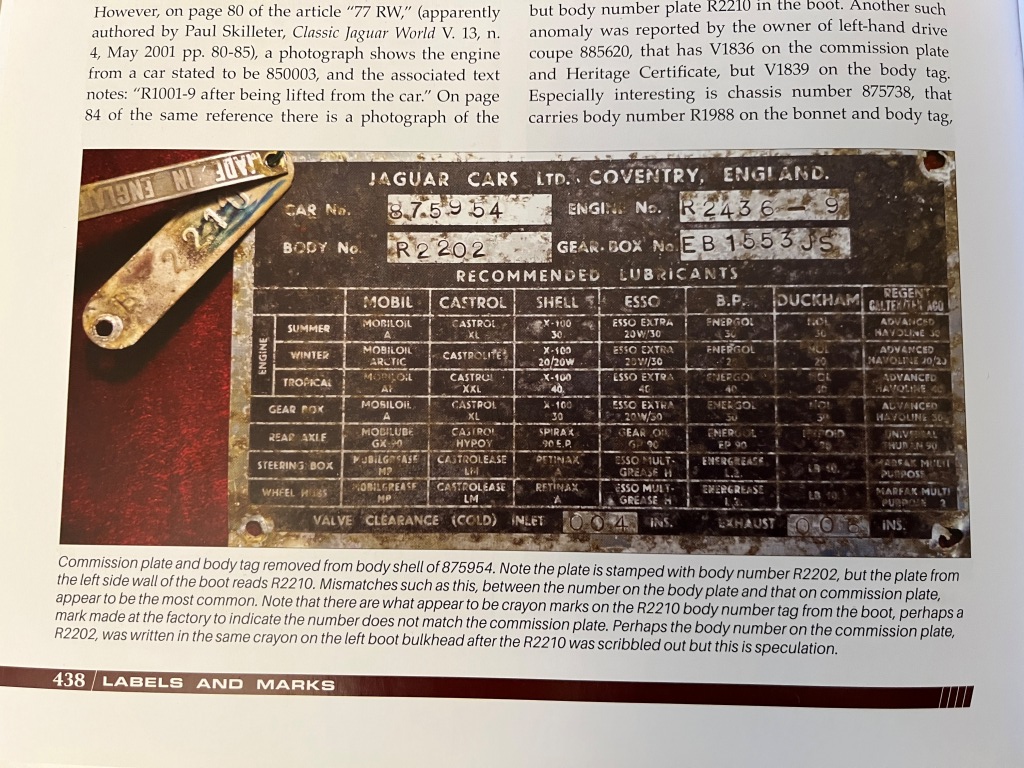
Recently I visited the Coventry Foundation in Columbia, SC in order to meet, greet, and thank Dr. Thomas Haddock, who was visiting there to do some research. Dr. Haddock is the co-author of the 500+ page book “Jaguar E-Type Six-Cylinder Originality Guide”. I refer to this book quite a bit and wanted to take this opportunity to personally thank Dr. Haddock for putting in the work to produce this book. Well, one thing led to another and I presented Dr. Haddock that facts as I knew them about my body number descrepency. George Camp, the director of the Coventry Foundation, also participated. First, both generally agreed that documentation errors were made both orginally at the factory and currently by the folks that produce the Heritage Certificates. As we got into the specifics of my case, I recounted to Dr. Haddock the observation that an alternate body number could be seen in blue crayon next to my body number tag. Dr. Haddock immediately picked up on the significance of this. He directed me to page 438 in his book, where there was a picture of a body number tag where there was a “strikethrough” of the number on the tag, in blue crayon. We then pulled up the photo of my body tag.
I had not noticed this before but in addition to the faint evidence of body number 4955 having been applied in blue crayon to the sheet metal above the tag, the tag itself had a strikethrough in blue crayon. Dr. Haddock and George Camp both discussed that the metal body tag was applied by the Abby Panels as a form of inventory control as their products left their facility and were sent to Coventry. At Coventry, bodies to some degree were sent to the assembly line not neccesarily in order of Abby Panels tag number, as it might be more efficient to take the one closest to the warehouse door, so to speak. These pictures from Porter’s book give you an idea of why that could be the case.
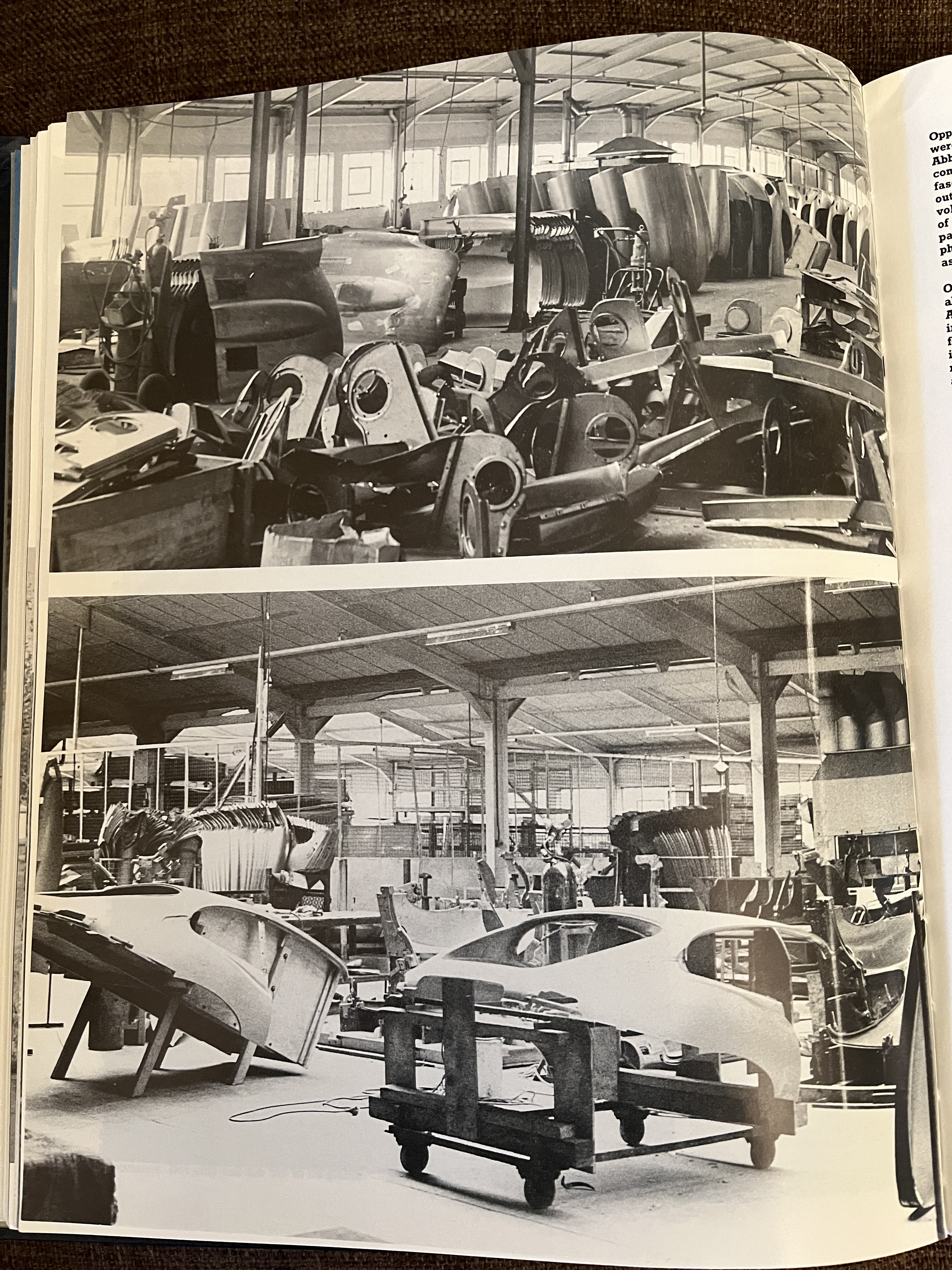
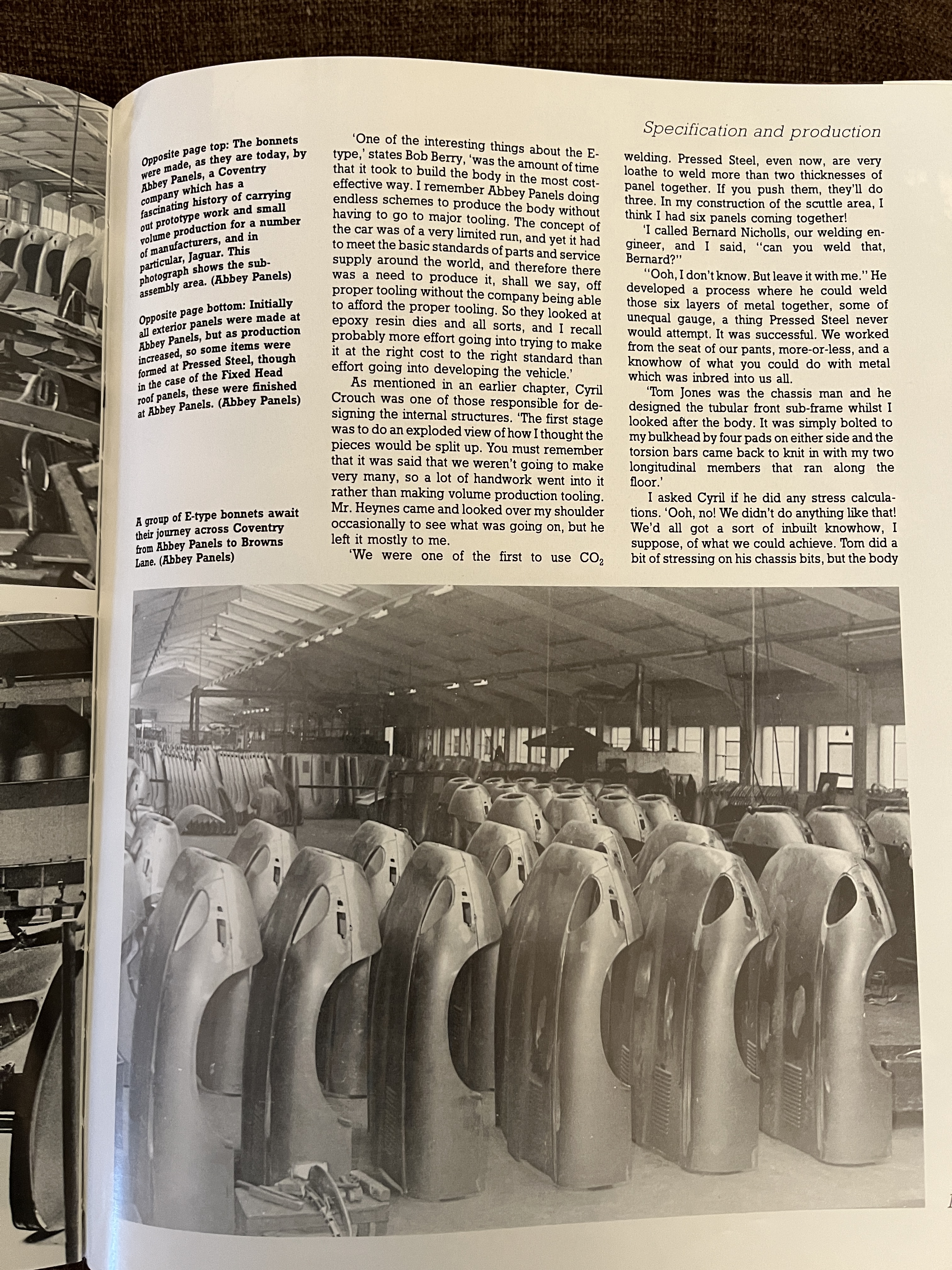
Both Dr. Haddock and George Camp felt that the Body Number written in blue crayon was the one the car went down the assembly line with. It agrees with the number on the Commision Plate and the Heritage Certificate. As such, the number imprinted on the metal body tag, V5139, is not the “matching” body number for this car. 4955 is the matching number. It will remain a mystery why the Jaguar Heritage Trust records show this same tag number to have been used in a car that went down the assembly line ~45 days later. I would hazard to guess that the metal tag on that car has been “corrected” with blue crayon, just like mine.
As additional supporting evidence, I am currently installing upholstery. Fortunately most of the original pieces are still available for inspection. Here are photos of two that I found with the 4955 number. In conclusion, I think it is safe to say that my 1963 FHC is a “matching numbers” car with respect to the body.
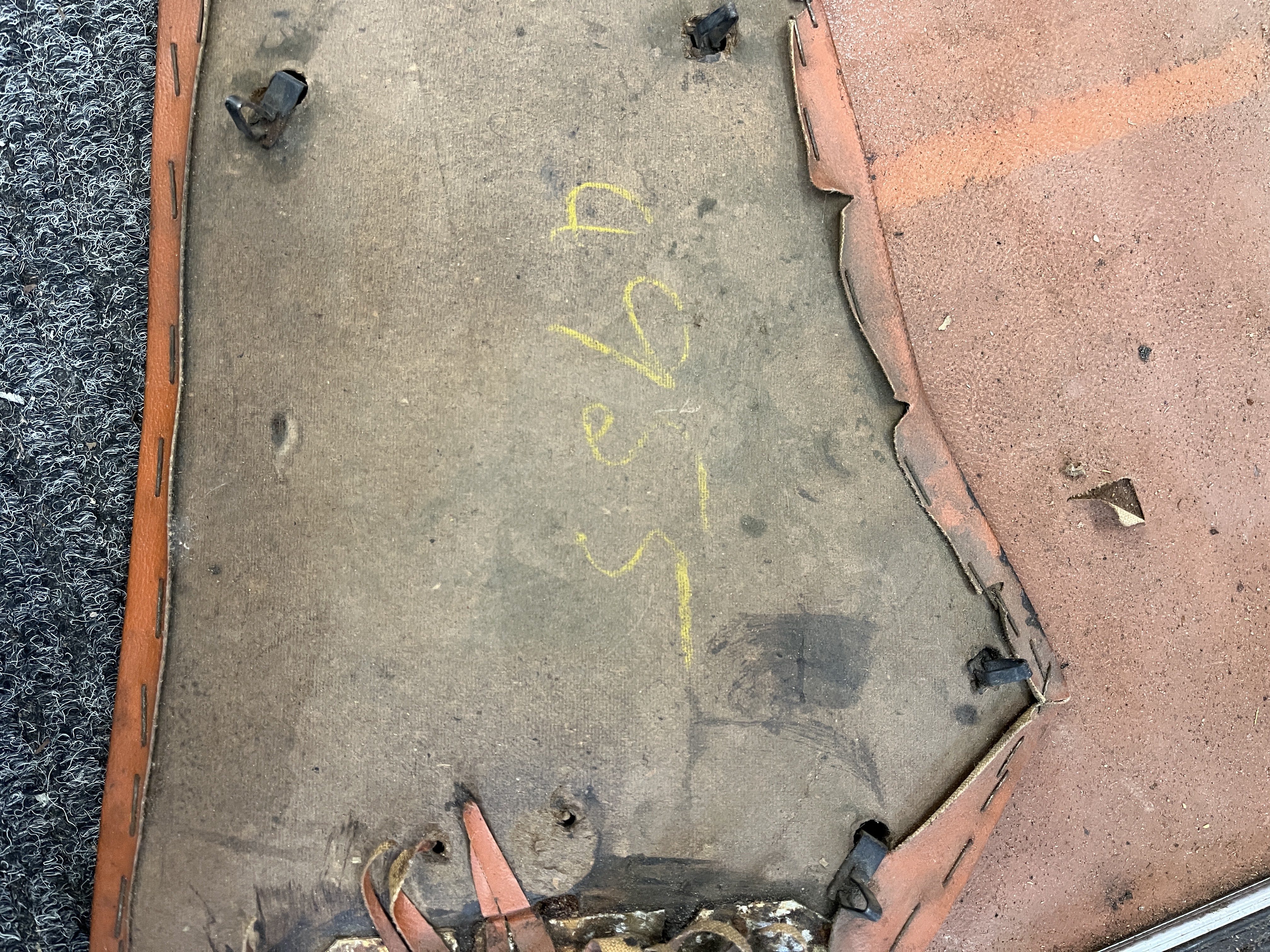
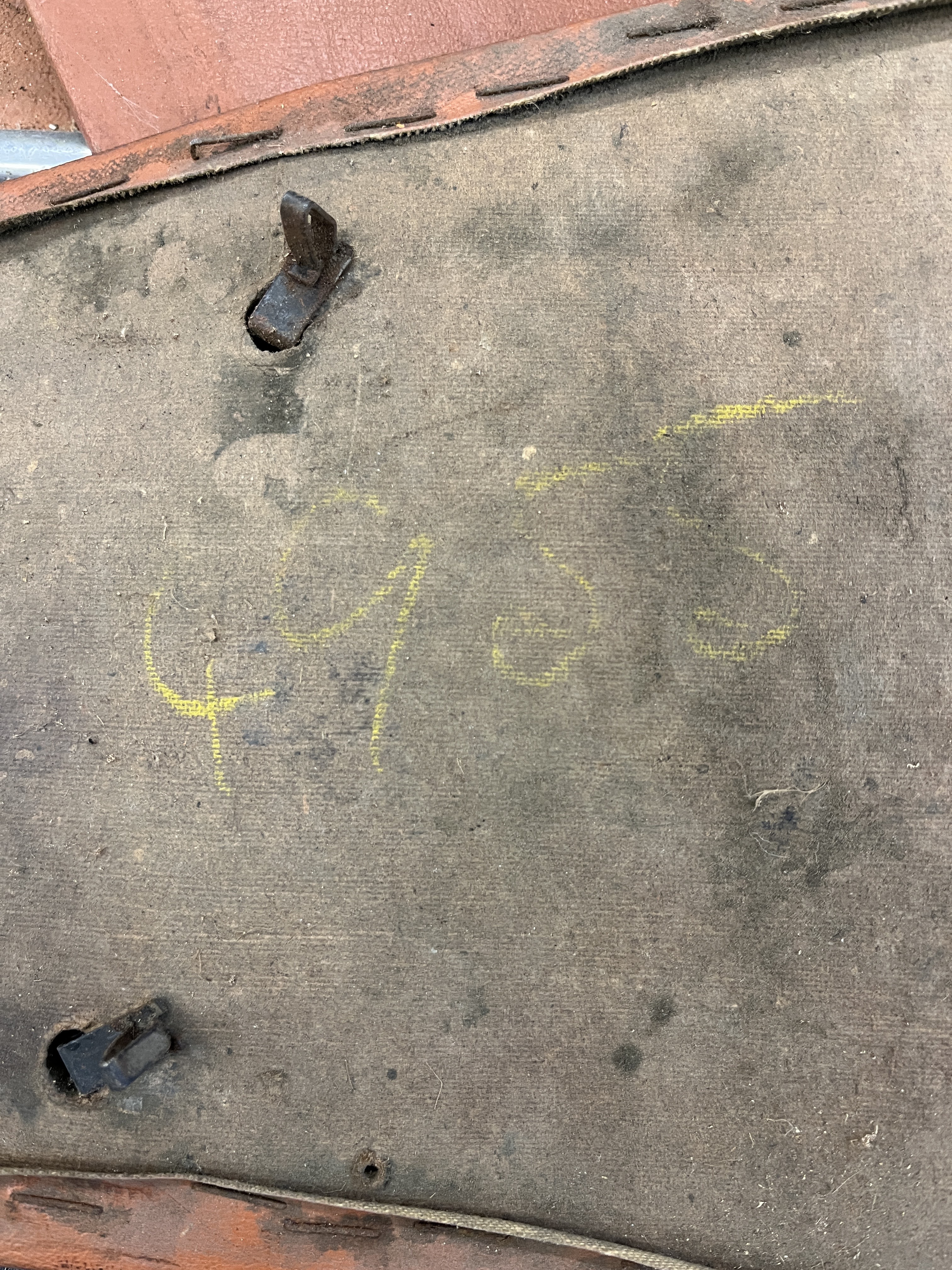
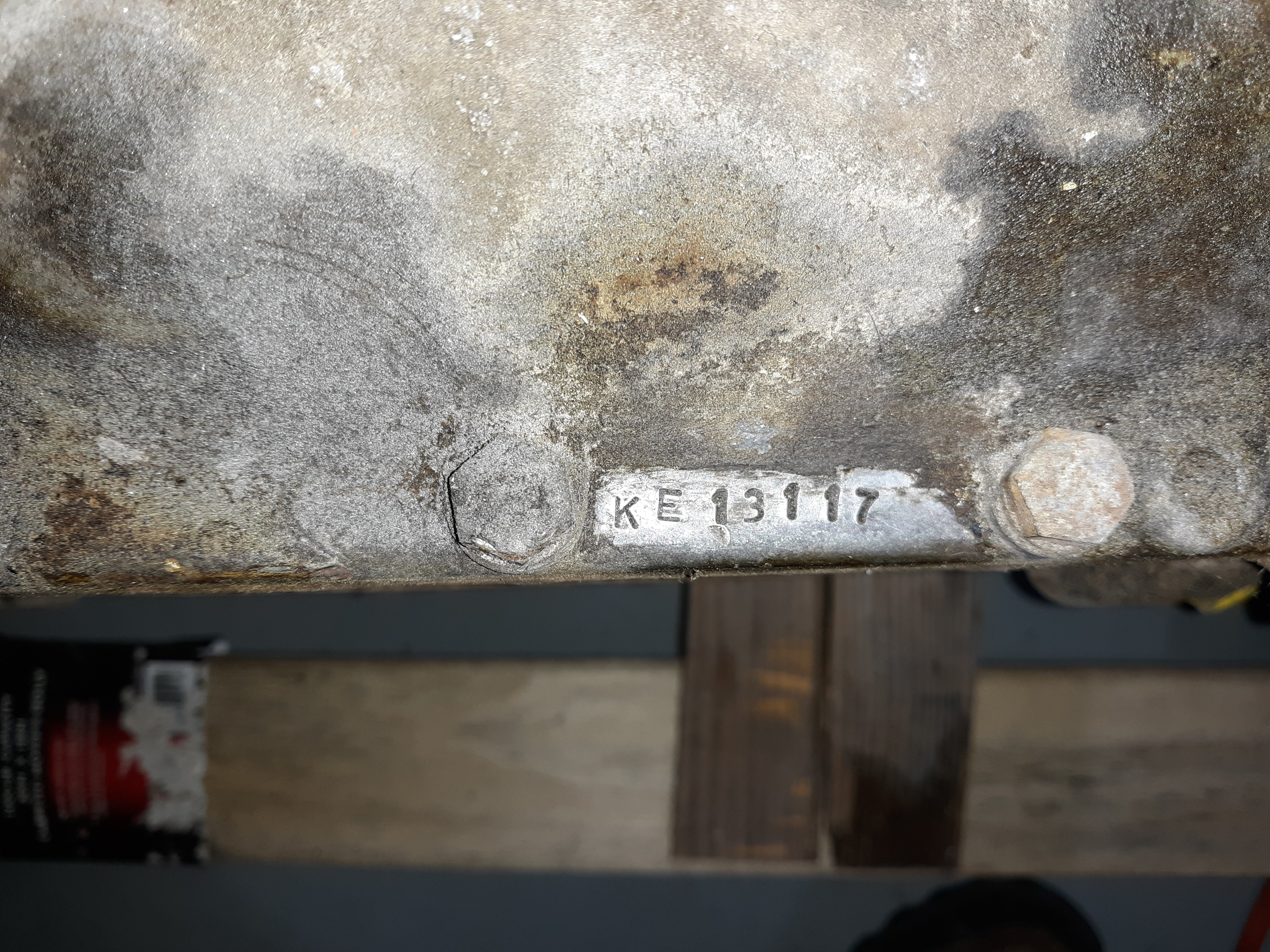
Finally, there is the Gearbox Number. This one doesn’t match for an obvious reason. The transmission I received with my pile of parts is the more modern fully syncromesh transmission that Jaguar started installing in Etypes in 1964. The transmission original to the car would have been the infamous Moss gearbox. This gearbox was used by Jaguar for many years. It lacks syncros in first gear. Shifting a Mossbox can be an “acquired taste” but many of the early cars have been updated to the later gearbox for ease of driving. The number on the transmission that will be installed in this car is KE 13117. Based on a little internet sluething, this transmission would appear to be a Standard Ratio transmission from a Series II car. I have sent it to Dick Maury at Conventry West for detailed inspection and any necessary repairs.
 New Hill Garage
Discussion
Comments are closed.