Jaguar used a specific coolant hose clamp on the E-Type, commonly referred to as a Cheney clamp. Prolific Jaguar historian David Jones says “Cheney was a U.K. based OEM of Double Grip worm-drive hose clamps used on 50s-60s Jaguars.” These are generally considered to be the only Authentic clamp which can be used on an E-Type for showing in the Champion class. The JCNA Series 1 E-Type Judging Guide states “Hose Clamps – Cheney and Regent – round screw – band slots not cut through – cadmium-plated”. (So every time I read something, I see something new. There is possibly a Regent brand of clamp out there that is also authentic? Has anyone ever seen one?)
On my 63 E-Type FHC restoration, I thus used Cheney clamps on all the coolant hoses. As noted in the judging guide, they can be visually identified as having a round head on the “screw” that engages the worm drive to tighten the clamp. The screw head is single slot. Many “improved” clamp designs used a hex head for the screw head and in some cases a Phillips slot. If you look carefully on the body of the worm drive, you can see the Cheney logo. As a counterpoint, I have included a picture of a Jubilee clamp, which is very similar but has the hex head.
My boxes of parts did not include any Cheney clamps. I eventually turned to E-Type mechanic extraordinaire Dick Maury, who had Cheney clamps listed on his Ebay store Maurys Market. I called Dick at one point and asked if he was at risk of running out of these clamps. Interestingly, he said he had a big bucket full of them that he had pulled off cars back in the day. I think the inference was that there were better clamps out there and getting the OEM clamps off the cars was a wise preventive maintenance decision.
Well, I am now beginning to see the wisdom in his actions. Understand, my car is a garage queen. It is rarely driven, although I try and start it up every few weeks. I let it idle for 10 minutes or so to get the engine warmed up. The other day, after this modest bit of automotive exercise, I came out later to find a puddle of what turned out to be coolant under the car. This is not the first time. During initial startup and shakedown, I had multiple coolant leaks. All were resolved by tightening the Cheney clamp at the offending connection. In one case, down on the odd shaped hose coming off the bottom of the water pump, I added a second modern clamp because the Cheney clamp just wouldn’t tighten sufficiently. In its defense, the coolant hose I had to use was not a good fit on the water pump outlet casting. It needed a significant amount of squishing to get it to seal. Note that a lot of modern metal coolant hose connections have an external bead formed into them, which dramatically improves the seal of the hose. Anyway, I pulled out my now much used coolant system pressurizing pump and identified the leak as coming from the hose that goes from the firewall to the heater box. Note that Jaguar ran hard metal hoses in the interior of the car from one side of the engine compartment to the other. These are infamously difficult to access after the fact if a repair is needed. Fortunately, my car has all new stainless pipes but they never did and still do not have a bead rolled into the end of the pipe. As such, the connection is vulnerable to leaks. Whatever, mine was leaking. I actually had to partially remove the heater box to get at the offending clamp and tighten it up. Even worse, I found that a substantial amount of coolant had made its way into the interior driver’s side footwell. My own little flood event. I pulled the carpets and the jute padding for cleaning and drying. BTW jute has an extraordinary capacity to absorb water. I took the carpet and the jute to my laundry sink and repeatably rinsed them in hot water until I was satisfied that the coolant had been flushed out. The carpets air dried in less than 24 hours. The jute, casually laid in the bottom of the sink, was still wet 2 days later. I then hung them outside for another 2 days. They are finally beginning to feel dry. So a word of warning. If you ever get your footwells wet, be proactive about removing any carpet padding, especially the authentic jute material, and get it good and dried out.
This is an exasperating problem. The Cheney clamps are required in order to get a good score at a concours judging. And they seem to hold up, until they don’t. I suspect part of the problem is that we have to replate the old clamps with cadmium or zinc and the grooves that engage the worm drive lose some of their definition. And one needs to keep an eye on their degree of tightness. This is a delicate balance, as I am sure you could overtighten them if you are not careful. BTW it has been reported that a reproduction Cheney clamp is being marketed by one of our parts suppliers. Feedback on the forums is that it is not very good.
So that is my sad story of the day. A first world problem, to be sure. One of the joys of old car ownership.

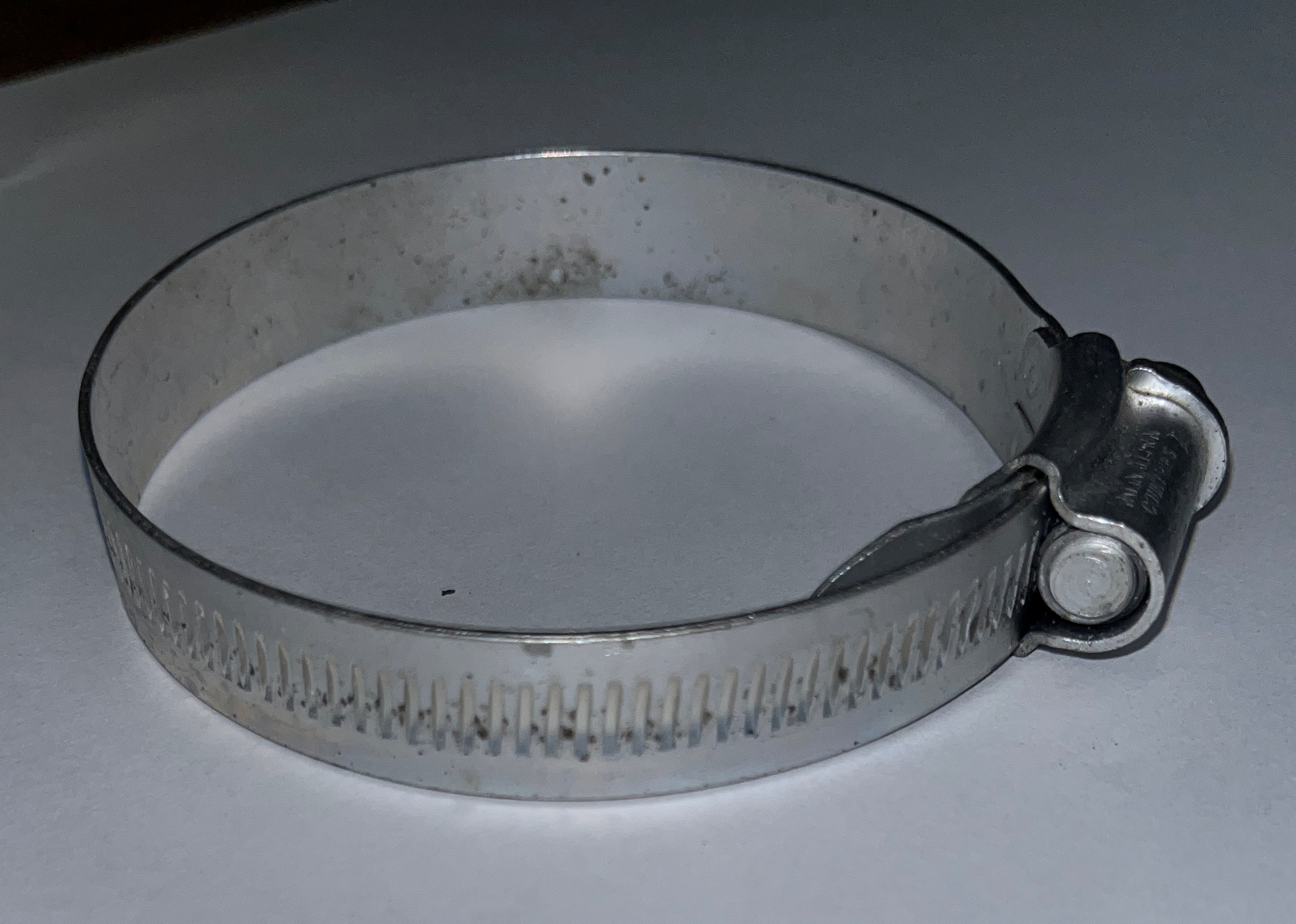


Update- After initially publishing this article within the Carolina Jaguar Club newsletter, the Litter Box, I received the following commentary from Dick Maury.
Hi Harvey, just read your article on hose clamps. Here is a link with
pictures that might be of interest.
https://www.georgiajag.com/Documents/Cheney%20Clamps.htm
The problem with the original Cheneys is they are mild steel. They seem
to stretch when heat cycled so occasional tightening is required.
Because of this in the past, when putting on new hoses, we replaced the
clamps with new stainless steel clamps that did not require further
attention. Imagine telling a V12 E-Type owner to drop his car off to
have his clamps tightened. 52 clamps on a V12 E-Type by the way. The
article has pictures of the Regent clamps as well as early Jubilee
clamps which were “cheese” head, not hex. The judging guide was relaxed
to allow clamps that had a single slot, round head and the band not cut
through to be acceptable for concours. There are other clamps out there
meeting this criteria. Some are in my article and I have them if anyone
is interested.
The problem with the reproduction clamps is they are made of a soft
metal, chrome plated and fall apart if tightened enough for the hose not
to leak. The ones I have seen on EBAY all have the same head and
markings. Each different size Cheney has a different head with
different stampings to show the size/part number.
 New Hill Garage
Discussion
Comments are closed.